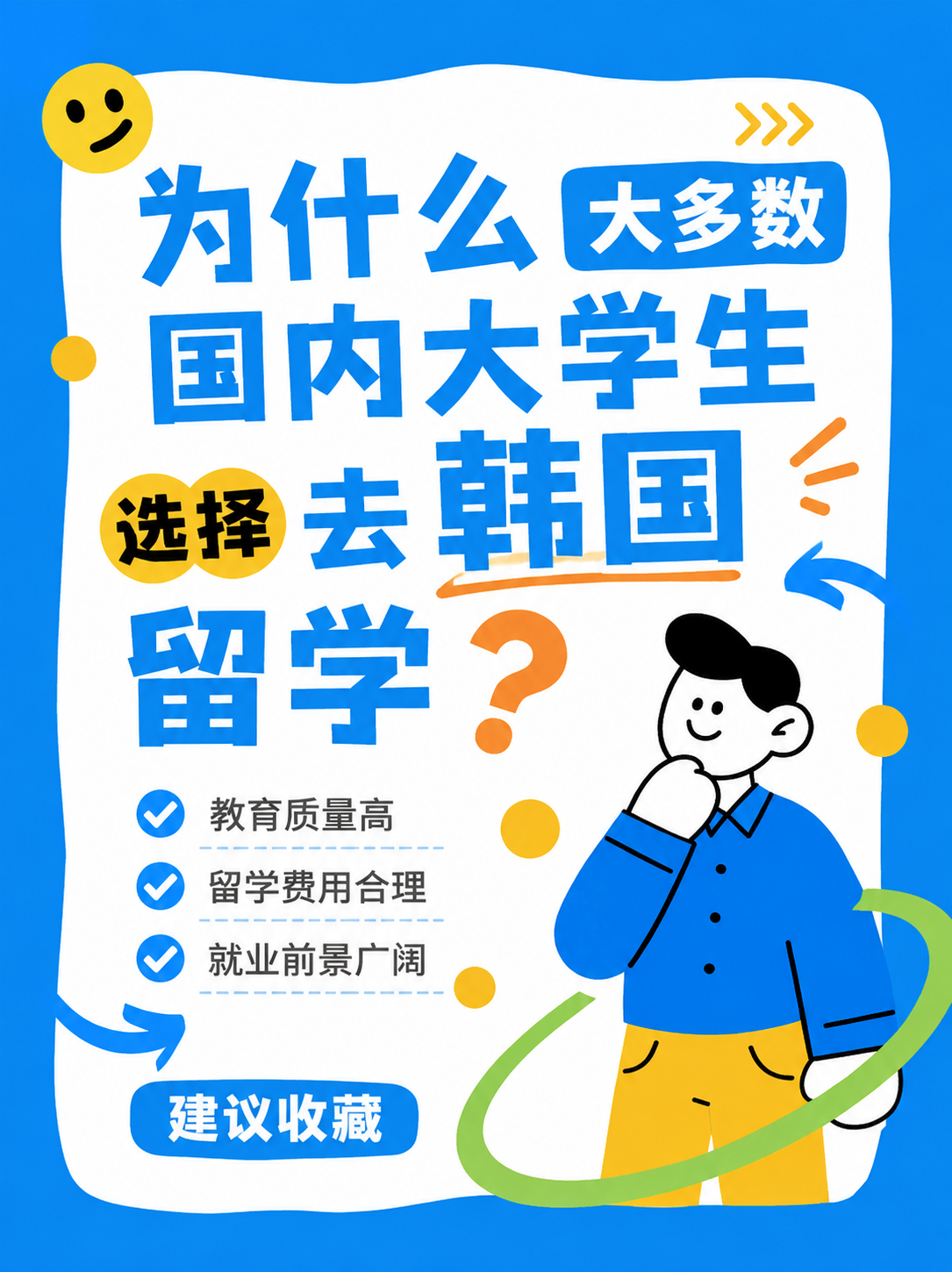
1. The economy is extremely cost-effective and affordable for working families (the core motivation)
- The overall cost is much lower than that of mainstream European and American countries: the annual tuition + living expenses of Seoul Private University is about 100,000 - 150,000 yuan, and the annual tuition of local national universities such as Busan and Daegu is only 60,000 - 80,000 yuan, which is three of the annual tuition fees of the United States and the United States. Less than one, ordinary families are less stressed.
- Scholarships for international students cover a wide range of areas: as long as the Korean TOPIK score is up to standard, the tuition fee will be directly reduced by 30%-100% in the first semester, and those with excellent scores will receive a full scholarship; the tuition fee of the national university itself is low, and the actual expenditure after the reduction has been significantly reduced.
- Legal part-time subsidy income: Students can work 25 hours a week in compliance with regulations. There are many options for coffee shops, convenience stores, Chinese tutoring, and translation positions, which can cover most of the living expenses and further reduce the burden on families.
2. The application threshold is loose and extremely friendly to ordinary undergraduate backgrounds
- Postgraduate adoptionMaterial review system, no unified written test, there is no internal examination. Double non-undergraduate courses with an average score of about 70 points can sprint to the top 300 Korean universities in the QS. There are few restrictions on college promotion and cross-professional applications, and many students use it to achieve a counterattack in their academic qualifications.The future of New Oriental...。
- The language path is very flexible: you can transition from a university affiliated language school with zero basics; you can enter an undergraduate course at TOPIK levels 3 - 4, and only require TOPIK level 4 for a master's degree; if you don't want to learn Korean, you can also choose GSIS business programs in all English, and some universities teach master's programs in Chinese., multiple landing channelsThe future of New Oriental...。
- The visa policy continues to be relaxed: e-visa approval can be issued within 3 working days at the earliest, the deposit certificate threshold has been lowered, the materials are simple, the refusal rate is low, and the application process is worry-free.
3. The degree of geographical and cultural adaptation is full, and life adaptation is zero pressure.
- Close distance and extremely small time difference: It only takes 1.5 - 3 hours to fly from China to Seoul, and the time difference is only 1 hour. You can travel back and forth at any time during holidays. It is very convenient to return home when you are sick or homesick, and parents feel more at ease.
- East Asian cultures have the same origin and living habits are similar: there are small differences in food tastes, social etiquette, and thinking logic. Chinese restaurants and Super League are all located around major universities. There will be no serious cultural barriers and eating discomfort, and psychological loneliness is much lower than in European and American countries.
- The city's supporting facilities are complete: the subway is fully covered, 24-hour convenience stores can be seen everywhere, the online shopping, takeout, and payment systems are mature, and daily life is not much different from that in China.
4. Outstanding professional strength and strong employment competitiveness in characteristic majors
- Art and media are trump strengths: film and television director, visual design, new media media, performance, beauty and beauty, interior design, hotel management teaching systems are extremely industry-oriented, with many practical courses, and have returned to China from media, film and television companies, and medical beauty industry. It is highly recognized and is also the preferred direction for a large number of art students.
- Endorsement of hard-core industries in science and engineering: Semiconductor, electronic engineering, automobile manufacturing, artificial intelligence, and biomedicine rely on the in-depth integration of industry-research and research by leading companies such as Samsung and Hyundai. The courses are closely related to the forefront of the industry. Whether they stay in Korea to enter large factories or return to China to enter technology companies, they are very popular.
- Business, international trade, and Korean translation are suitable for cross-border positions. Trade exchanges between China and South Korea are frequent, and bilingual talents are very popular in foreign trade, cross-border e-commerce, and Korean companies in China.
5. High academic recognition and diverse subsequent development paths
- All formal college degrees can complete the secondary school service certification, and all subsidies for returning to China for public examinations, examinations for editors, state-owned enterprises, settling in first-tier cities, and talent introduction are recognized, and the gold content is guaranteed by the government.
- There are three development routes to choose freely: ① To study in South Korea to work, you can apply for a D-10 job visa for up to 3 years after graduation and stay in a Korean company to find employment;② Go back to China directly to find employment, relying on the overseas study background + Korean advantage to add points;③ Use South Korea as a springboard, and apply for a second master's degree or doctorate from a prestigious European and American university will be less difficult to apply forThe future of New Oriental...。
6. Additional soft appeal
- The campus atmosphere is rich and free: popular idols are invited to hold concerts at the university celebration, academic pressure is controllable, suspension of school and entrepreneurship, gap year planning is supported, and after-school life experience is strong.
- Language added value: Proficiency in bilingual Korean + English has become a differentiated advantage in resumes. It is a hard-core bonus for students who want to enter Korean companies and do cross-border business between China and South Korea.
simple summary
For college students with limited budgets, average undergraduate backgrounds, who want to steadily improve their academic qualifications, want to study media art and design, and plan to engage in cross-border work between China and South Korea, studying in South Korea is a very balanced choice with a very balanced input-output ratio, which is also the reason why the application popularity has continued to rise in recent years.